


Next: Solution Up: Homework Solutions Previous: Solution
Show that the derivative of an integral is given by
By generalizing to three dimensions show that the material derivative of an integral of fluid property is given by where the surface integral is over the surface bounding the volume
 .
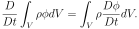
Hence show that
.
Hence show that

![$\displaystyle \frac{D}{D t} \int_V \phi(x,t) d V = \int \frac{\partial \phi}{\p...
...t_V\left[\frac{\partial \phi}{\partial t} + \nabla\cdot({\bf v}\phi)\right]d V.$](img53.svg)