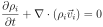
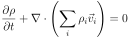
Problem 3: We are asked to explain why there is no diffusion term in the mass continuity equation. The mass continuity equation (eq 1.33b pg 10) is given by:
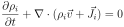
or equivalently,
We start by deriving the local form of the mass continueity equation. We define the mass  in a volume
  as:
as:
Now we impose the conservation of mass. Thus we have:
Now we can evaluate this time derivative using Reynolds transport theorem derived in problem 2.3 as follows:
Since this holds for any arbitrary volume, the integrand must be zero. Thus we have the local form of the mass continuity equation:
We continue by rewriting this equation in terms of the diffusion flux of species  . We start by adding and subtracting
 inside the divergence operator.
where  is the diffusion flux of species relative to bulk velocity
  . Diffusion refers to the extra movement of a particular species beyond just moving with the surroundings driven by a physical process (i.e. Ficks Law is driven by the consentration gradient
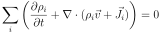
 ). Summing over all species (each term in the sum is zero), we have:
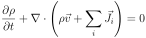
Using the linearity of the derivative and divergence operators, we can rewrite this as:
Now we see that this works because the diffusion from each species cancels out when we sum over all species. The Diffusion term is simply a redistribution of mass, not the creation or destruction of mass. Thus, there is no diffusion term in the mass continuity equation for all species combined.