Solution

Problem 1.1: Show the following:

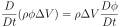
$\displaystyle \frac{D}{Dt}(\rho \phi \Delta V) = \rho \Delta V \frac{D \phi}{Dt}$

We start with the definition of the material derivative for a scalar field (eq 1.7 pg 5):

$\displaystyle \frac{D \phi}{Dt} = \frac{\partial \phi}{\partial t} + \vec{v}\cdot\nabla \phi$

Recall that this relation is really just the total derivative of $\phi$ with respect to time.

$\displaystyle \frac{D \phi}{Dt} = \frac{d}{dt} \phi(\vec{x}(t),t) = \frac{\part...
...al z}\frac{dz}{dt} = \frac{\partial \phi}{\partial t} + \vec{v}\cdot\nabla \phi$

We start with the left hand side and apply the definition of the material derivative and the conservation of mass ( $m = \rho \Delta V$, so $\frac{Dm}{Dt} = 0$):

$\displaystyle \frac{D}{Dt} \rho \phi \Delta V$ $\displaystyle = \frac{\partial}{\partial t}(\rho \phi\Delta V) + \vec{v}\cdot\nabla(\rho \phi \Delta V)$    
  $\displaystyle = \rho \Delta V \left(\frac{\partial \phi}{\partial t} + \vec{v}\...
...Delta V \left(\frac{\partial}{\partial t} \rho + \vec{v}\cdot\nabla \rho\right)$    
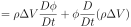
  $\displaystyle = \rho \Delta V \frac{D \phi}{Dt} + \phi \frac{\partial}{\partial t}(\rho \Delta V) + \phi \vec{v}\cdot\nabla(\rho \Delta V)$    
  $\displaystyle = \rho \Delta V \frac{D \phi}{Dt} + \phi \frac{D}{Dt}(\rho \Delta V)$    
  $\displaystyle = \rho \Delta V \frac{D \phi}{Dt}$    

Problem 1.2: Deduce that

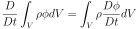
$\displaystyle \frac{D}{Dt} \int_{V} \rho \phi dV = \int_{V} \rho \frac{D \phi}{Dt} dV$

We start by using Reynolds transport theorem. Then, Green's theorem is used to convert the surface integral to a volume integral. The next few steps are applications of the product rule. We collect terms of $\phi$ and $\rho$ and then apply the definition of the material derivative. Finally, we use the mass continuity equation (eq 1.33b pg 10) to simplify and obtain the result.

$\displaystyle \frac{D}{Dt} \int_{V(t)} \rho \phi dV$ $\displaystyle = \int_{V(t)} \frac{\partial}{\partial t}(\rho \phi) dV + \int_{\partial V(t)} \rho \phi \vec{v}\cdot \vec{dS}$    
  $\displaystyle = \int_{V(t)} \frac{\partial}{\partial t}(\rho \phi) dV + \int_{V(t)} \nabla \cdot (\rho \phi \vec{v}) dV$    
  $\displaystyle = \int_{V(t)} \frac{\partial}{\partial t}(\rho \phi) + \vec{v}\cdot\nabla(\rho \phi) + \rho \phi (\nabla \cdot \vec{v}) dV$    
  $\displaystyle = \int_{V(t)} \rho \frac{\partial \phi}{\partial t} + \phi \frac{...
...nabla \phi + \phi \vec{v}\cdot\nabla \rho + \rho \phi (\nabla \cdot \vec{v}) dV$    
  $\displaystyle = \int_{V(t)} \rho \left(\frac{\partial \phi}{\partial t} + \vec{...
...}{\partial t} + \vec{v}\cdot\nabla \rho + \rho (\nabla \cdot \vec{v})\right) dV$    
  $\displaystyle = \int_{V(t)} \rho \frac{D \phi}{Dt} + \phi \left(\frac{D \rho}{Dt} + \rho (\nabla \cdot \vec{v})\right) dV$    
  $\displaystyle = \int_{V(t)} \rho \frac{D \phi}{Dt} dV$