


Next: Third Problem Up: Second Problem Previous: Second Problem
Problem 2.1: We are asked to show that the derivative of an integral is given by the following:

 as the antiderivative of
  with respect to
  (i.e.
(i.e.  for the 1D case). Then we continue by computing the total derivative with respect to time using the chain rule. Next, we can invoke the fundemental theorem of calculus again to rewrite the equation in terms of
  . Finally, we note that the definition of the partial derivative holds all other variables constant, i.e.
  , and thus we can move the partial derivative with respect to time inside the integral as both are linear operators with standard continuity assuptions.
![$\displaystyle \frac{d}{dt} \int_{x_1(t)}^{x_2(t)} \phi(x,t) dV = \frac{d}{dt} \left[ \Phi(x_2(t),t) - \Phi(x_1(t),t) \right]$](img60.svg) |
||
![$\displaystyle = \left( \frac{\partial}{\partial t} \left[ \Phi(x_2,t) \right] +...
...ft[ \Phi(x_1, t) \right] \frac{\partial}{\partial t} \left[ x_1 \right] \right)$](img61.svg) |
||
![$\displaystyle = \left( \frac{\partial}{\partial t} \left[ \Phi(x_2,t) \right] +...
...left[ \Phi(x_1,t) \right] + \phi(x_1,t) \frac{\partial x_1}{\partial t} \right)$](img62.svg) |
||
![$\displaystyle = \left( \frac{\partial}{\partial t} \left[ \Phi(x_2,t) \right] -...
...) \frac{\partial x_2}{\partial t} - \phi(x_1,t) \frac{\partial x_1}{\partial t}$](img63.svg) |
||
 |
||
 |
Problem 2.2:
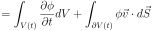
We are now asked to generalize this result to 3D. Thus, we want to show that:

 ,
,  , and
, and  .
.
 |
 |
|
 |
||
 |
. Finally, we combine the results into a single equation using vector notation and the definition of the velocity vector,
 and the del operator,
 .
.
|
|
|
 |
||
 |
||
 |
 |
 |
|
|
|
|
||
 |
||
 |
||
 |
Problem 2.3:
We are now asked to generalize this result to 3D. Thus, we want to show that:
 ,
,  , and
, and  dimensions using Fubini's theorem. We define the space of integration as
![$V = [x_1(t), x_2(t)] \times [y_1(x,t), y_2(x,t)] \times [z_1(x,y,t), z_2(x,y,t)]$](img87.svg) . We then apply the 1D Leibniz integral rule to the outermost integral, apply the fundemental theorem of calculus, and then expand using the product rule.
. We then apply the 1D Leibniz integral rule to the outermost integral, apply the fundemental theorem of calculus, and then expand using the product rule.
 |
||
 |
||
![$\displaystyle = \int_{V(t)} \frac{\partial \phi}{\partial t} dV + \int_{x_1}^{x...
...t[\int_{y_1}^{y_2} \int_{z_1}^{z_2} \phi(x,y,z,t) dzdy \frac{dx}{dt} \right] dx$](img90.svg) |
||
![$\displaystyle = \int_{V(t)} \frac{\partial \phi}{\partial t} dV + \int_{x_1}^{x...
... \int_{z_1}^{z_2} \phi(x,y,z,t) dzdy \frac{d}{dx}\left[ \frac{dx}{dt}\right] dx$](img91.svg) |
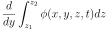
Now, we need to apply Leibniz integral rule but now with respect to . We then use the fundemental theorem of calculus to rewrite the result in terms of an integral and apply the product rule to expand the expression.
![$\displaystyle \frac{d}{dx} \int_{y_1}^{y_2} \int_{z_1}^{z_2} \phi(x,y,z,t) dzdy...
...2}\frac{d}{dy} \left[ \int_{z_1}^{z_2} \phi(x,y,z,t) dz \frac{dy}{dx}\right] dy$](img92.svg) |
||
![$\displaystyle = \int_{y_1}^{y_2}\int_{z_1}^{z_2} \frac{\partial \phi}{\partial ...
..._2} \int_{z_1}^{z_2} \phi(x,y,z,t) dz \frac{d}{dy}\left[\frac{dy}{dx}\right] dy$](img93.svg) |
. We then use the fundemental theorem of calculus to rewrite the result in terms of an integral and apply the product rule.
 |
![$\displaystyle = \int_{z_1}^{z_2} \frac{\partial}{\partial y} \phi(x,y,z,t) dz + \int_{z_1}^{z_2} \frac{d}{dz} \left[ \phi(x,y,z,t) \frac{dz}{dy} \right] dz$](img95.svg) |
|
![$\displaystyle = \int_{z_1}^{z_2} \frac{\partial \phi}{\partial y} dz + \int_{z_...
...} dz + \int_{z_1}^{z_2} \phi(x,y,z,t) \frac{d}{dz}\left[\frac{dz}{dy}\right] dz$](img96.svg) |
and the del operator,
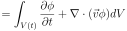
. Lastly, we use the product rule to combine the terms into the final result.
|
||
![$\displaystyle = \int_{V(t)} \frac{\partial \phi}{\partial t} + \frac{\partial \...
...dt} + \phi \frac{d}{dz}\left[ \frac{dz}{dy}\frac{dy}{dx}\frac{dx}{dt}\right] dV$](img97.svg) |
||
![$\displaystyle = \int_{V(t)} \frac{\partial \phi}{\partial t} + \frac{\partial \...
...hi}{\partial z} \frac{dz}{dt} + \phi \frac{d}{dz}\left[ \frac{dz}{dt}\right] dV$](img98.svg) |
||
 |
||
 |