


Next: FPUT Hamiltonian lecture Up: Lecture Notes Previous: Fourier transform:
A physically natural quadratic nonlinearity for thin elastic structures arises from **geometric nonlinearities** due to stretching of the midplane when the deflections are moderate but not infinitesimal. For a one-dimensional beam, the lowest-order nonlinear contribution to the bending strain can be expressed as the derivative of the squared slope:

where  is the transverse displacement. This term is **quadratic in the amplitude** and represents the nonlinear coupling between curvature and slope, producing energy transfer between modes.
In two dimensions, for a thin plate or membrane  , the corresponding geometric quadratic nonlinearity involves both spatial directions and can be written as

where
 and
and
 .
Physically, this term captures the stretching of the midplane in both directions, generating **mode interactions in 2D** and allowing the transfer of energy among different linear eigenmodes of the plate.
It is a minimal quadratic model that retains the essential physics of **triad resonances, amplitude-dependent frequency shifts, and nonlinear wave propagation** while remaining analytically tractable.
.
Physically, this term captures the stretching of the midplane in both directions, generating **mode interactions in 2D** and allowing the transfer of energy among different linear eigenmodes of the plate.
It is a minimal quadratic model that retains the essential physics of **triad resonances, amplitude-dependent frequency shifts, and nonlinear wave propagation** while remaining analytically tractable.
Introducing a physically natural quadratic nonlinearity of the form
 ,
the full nonlinear plate equation reads:
,
the full nonlinear plate equation reads:

where
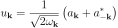 is a small parameter controlling the
strength of the nonlinearity.
is a small parameter controlling the
strength of the nonlinearity.
![$\displaystyle H =
\int \left[
\frac{1}{2}\,u_t^2
+ \frac{1}{2}\left(u_{xx}^2 + ...
...2\right)
- \frac{\varepsilon}{2}\,u\left(u_x^2 + u_y^2\right)
\right]\;dx\,dy .$](img60.svg) |
(12) |
 |
(9) |
 |
(10) |
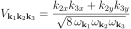 |
(11) |
 |
(12) |
 |
(13) |
 |
(14) |
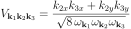 |
(15) |
|
(9) |
|
(10) |
|
(11) |
 |
(12) |
 |
(13) |
|
(14) |
 |
(15) |