Next: Why Numerical Computing by Up: Possible Problems for Exams Previous: Possible Problems for Exams
In IEEE single precision, numbers have the form

Step 1: Representation of  .
.

Thus the stored exponent is  and the significand has all zero fraction bits.
Step 2: Spacing (ULP) at .
For a normalized number with exponent  , the spacing between adjacent floating point numbers is

Step 3: Number that follows .

Binary:

Decimal:

Step 4: Number that precedes .

Binary:

Decimal:

Final answer:

Out of these numbers which ones can be represented exactly in the Single Precision Floating Point system? Justify your answer.




SOLUTION
In IEEE single precision, a real number is represented exactly if and only if
its binary expansion is finite and fits within 24 significant bits
(including the hidden leading  ). Equivalently, a rational number is
exactly representable if its denominator (in lowest terms) is a power of
). Equivalently, a rational number is
exactly representable if its denominator (in lowest terms) is a power of  .
.


 , so the binary expansion is infinite.





 , so the binary expansion is infinite.

 , hence the binary expansion is infinite.
Calculate approximately what fraction of Single Precision
Floating Point Numbers lie between 0 and  ?
SOLUTION
?
SOLUTION
Single precision IEEE floating point numbers consist of

Step 1: Count numbers between 0 and .
Since

 include:
 ,
,

 exponent values.
Each normalized exponent contributes 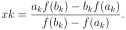 positive numbers.
Thus,

(Subnormals contribute only one additional exponent block and do not affect the estimate at leading order.)
Step 2: Total number of floating point numbers.
The total number of single precision floating point numbers is

Step 3: Fraction.

Final answer:

Consider the function
 and
analyze the resulting iterations. Do you get the quadratic
convergence to the root
and
analyze the resulting iterations. Do you get the quadratic
convergence to the root  ? Does the Newton method converge to
the root ?
? Does the Newton method converge to
the root ?
 does Newton's method converge?
 and describing the tangent lines
near the root.
and describing the tangent lines
near the root.
SOLUTION
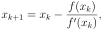
Newton's method is defined by

For
 , we have

Thus the Newton iteration becomes

Analysis: The iteration formula is

Clearly, the sequence does not converge to 0. Instead, the iterates alternate in sign and grow in magnitude:

Hence, Newton's method does not converge to the root for this function.
From the iteration formula
 , the magnitude of the iterates is

Thus, unless 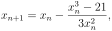 , the iterates diverge. The only "initial guess" that leads to the root is

The standard Newton convergence theorem states that if  is a simple root of
  (
( ,
,
 ) and the initial guess is sufficiently close to , then Newton's method converges quadratically.
Here, is a root, but
 is not a simple root in the sense of the theorem, and there is no contradiction: the conditions of the theorem are not satisfied.
The function
has a very steep slope near the origin. Its tangent line at a point
 is
is

Because  becomes very large as
  , the tangent line is nearly vertical, and the Newton step

A sketch of
and the tangent lines near the origin would show very steep tangents, causing iterates to overshoot and alternate signs.
A criticism of the bisection method is that it does not use the values
of  and
and  , only their signs. A way to use these values
is to find the equation of the straight line connecting
, only their signs. A way to use these values
is to find the equation of the straight line connecting
 and
and
 and then take
  to be the
point where the line intersects the x-axis. Other than this, the
bisection algorithm is unchanged. This is
known as the method of false position.
to be the
point where the line intersects the x-axis. Other than this, the
bisection algorithm is unchanged. This is
known as the method of false position.
(a) Show that

(b) To solve

 and
and  . Find
and
. Find
and  using the method of false position, and also find them using
the bisection method. Which method produces the more accurate values?
Which one requires more flops?
using the method of false position, and also find them using
the bisection method. Which method produces the more accurate values?
Which one requires more flops?
The method of false position (regula falsi) uses the line connecting
and
. The equation of the line is

Set  to find the x-intercept :

Thus,

 , , .
, , .
Method of false position:


Determine the new interval. Since
 , set
, set


Next iteration:

Bisection method:

Check the sign:
 , so
, so


Comparison:
- Accuracy: Method of false position produces
 and
and
 while bisection produces
  and
and
 . The false position method gives iterates closer to the root
 after the first iteration.
- Flops: Both methods require evaluating each iteration, but false position requires extra multiplications/divisions to compute from the weighted formula. Bisection only needs a simple average. Therefore, bisection is slightly cheaper in flops per iteration.
after the first iteration.
- Flops: Both methods require evaluating each iteration, but false position requires extra multiplications/divisions to compute from the weighted formula. Bisection only needs a simple average. Therefore, bisection is slightly cheaper in flops per iteration.
Suppose you came to the Ice Age, and computer in your Time Machine is broken. Suppose to come back to 2026 to complete the numerical computing exam, you need to calculate “three to the power one third”, i.e.

 ,
,  ,
,  and
and  . Set up the nonlinear equation that has
 as the solution.
 accuracy?
 accuracy?
Set up the nonlinear equation

Initial bracket: Since
 and
and
 , a suitable initial bracket is
![$\displaystyle [a_0, b_0] = [1, 2].
$](img316.svg)
Bisection algorithm: At each step, compute

 . If
. If
 , set
, set
 ; else set
 . Repeat until
 tolerance.
Number of steps for accuracy :
The bisection error after  steps satisfies

Set

Take logarithm base 2:
 steps
steps
Newton iteration for
 is
is

Check: Correct iteration formula:

Start with (a reasonable guess).
Convergence: Newton's method is quadratically convergent. For tolerance , typically 4–5 iterations suffice.
Estimation of steps: Roughly, the error decreases as

 (
(
 ), squaring the error rapidly reduces it below in 4 iterations.
Consider the function
 and
and
 .
For each of its two roots determine which of the two methods,
Newton or Bisection will converge faster to the given root?
To be more specific, you may assume that you are looking for,
say,
.
For each of its two roots determine which of the two methods,
Newton or Bisection will converge faster to the given root?
To be more specific, you may assume that you are looking for,
say,  accuracy, and you are starting the Bisection with
the interval
accuracy, and you are starting the Bisection with
the interval
![$[-0.1, 0.1]$](img336.svg) for the root and use the interval
for the root and use the interval
![$[0.4, 0.6]$](img337.svg) for the root
for the root  .
.
For the secant, Newton, and bisection methods: Looking at
iterative error when solving , which of these
methods converges to an error of  the fastest?
True or False:
the fastest?
True or False:
If Newton's method converges to a solution
for a particular choice of , then it will converge to for
any starting point between and  .
.
To get credit for this
problem, you will need to give comprehensive explanation of your
answer.
For compyting the midpoint  of an interval
 ![$[a,b]$](img342.svg) , which of the following two equations is prefereable in floating point system? Why? When? Devise
the example when the midpoint given be the equation lies outside
of the interval.
, which of the following two equations is prefereable in floating point system? Why? When? Devise
the example when the midpoint given be the equation lies outside
of the interval.
 ,
,
 .
.
Solve with three digits accuracy an equation

The “divide and average” method for computing a square root  of a given number
  can be formulated
as follows:
can be formulated
as follows:

 , i.e. that

Show that if

 , then the Newton method, converging to the root
 can be implemented without performing any divisions. new
Newton method for solving a scalar nonlinear equation
requires computation of the derivative of at each
iteration. Suppose that we instead replace the true derivative with a
constant value  , that is we use the iteration scheme

(a) Under what condition on value of will this scheme be locally
convergent?
(b) What is the convergence rate of this scheme?
(c) Is there any value of to give a quadratic convergence?
(a) For given values of  ,
,  , and
, and  , will the bisection
method use fewer or more steps to solve
, will the bisection
method use fewer or more steps to solve

(a) If  and
and  , then what is the maximum number of
steps the bisection method will require to solve
, then what is the maximum number of
steps the bisection method will require to solve  and
have at least six correct binary digits?
and
have at least six correct binary digits?
(c) Answer part (b) for the equation

A criticism of the bisection method is that it does not use the values
of and , only their signs. A way to use these values
is to find the equation of the straight line connecting
and
and then take to be the
point where the line intersects the x-axis. Other than this, the
bisection algorithm is unchanged. This is
known as the method of false position.
(a) Show that

(b) To solve
 and .
Find and using the method of false position, and also find
them using the bisection method. Which method produces the more
accurate values? Which one requires more flops?
and .
Find and using the method of false position, and also find
them using the bisection method. Which method produces the more
accurate values? Which one requires more flops?
True or False: If Newton’s method converges into a solution for
a particular choice of , then it will converge to for any
starting point between and .
If it is true, please explain why, if it is not true, give a counter example.
In class we have shown that Newton method
has quadratic rate of convergence for simple root (i.e. when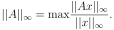 and
and
 ). In the homework you have shown that
convergence rate is linear for the double root.
). In the homework you have shown that
convergence rate is linear for the double root.
Proove, that Newton method has linear rate of convergence
for triple root, i.e. when
 .
.
Extra Credit Proove it for roots of multiplicity ,
i.e. when

 , , and . Set up the nonlinear equation that has
as the solution.
accuracy?
accuracy?
, , and . Set up the nonlinear equation that has
as the solution.
accuracy?
accuracy?




 .
.
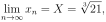
![$\sqrt[3]{21}$](img375.svg) , i.e.
, i.e.
![$\displaystyle \lim\limits_{n\to\infty}x_n=X=\sqrt[3]{21},$](img376.svg)
In class we have shown that fixed point iterations


To gain an intuition on this problem, consider the fixed point iterations

 . Start with . Then


 , yet
, yet
 .
Why is that?
.
Why is that?
Consider the function

As you see from the graph, this function has three roots, given by
 ,
,
 and
and
 .
.
The following two functions are defined as
 |
|||
 |
(5) |
 converges to the root
  .
.
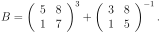 converges to
the root
converges to
the root  .
nor converge to the
root
.
nor converge to the
root  , regardless of the starting point.
.
, regardless of the starting point.
.
We have studied Secant method

 by iterations, and you have
obtained
by iterations, and you have
obtained
 and
and
 . Now use
linear interpolation to interpolate a straight line through these
two points, and choose
. Now use
linear interpolation to interpolate a straight line through these
two points, and choose  so that
 . What is the resulting method of solving that you
have derived?
Express the Newton iteration method for solving the following
system of nonlinear equations:
. What is the resulting method of solving that you
have derived?
Express the Newton iteration method for solving the following
system of nonlinear equations:

 .
.
Express the Newton iteration method for solving the following
system of nonlinear equations:
 |
|||
 |
.
Carry out one iteration of Newton's method applied to
the system
 |
 |
0 | |
 |
|
 |
![${\bf x}_{0}=[0,1]^{T}.$](img412.svg)
The following values for the solution of were computed
using Matlab. What method was used (bisection, Newton or secant)? Make sure you explain in details
why it is the method you claim:
X=50.25125628140704
X=25.378140640072242
X=12.944094811287638
X=6.7320923307183715
X=3.636103634563207
X=2.1079101939699143
X=1.3816957571715662
X=1.0826201384421688
X=1.0058580941730362
X=1.0000339198559194
X=1.0000000011504786
X=1.0000000000000000
X=1.0000000000000000
Chapter THREE
Show that for arbitrary square matrices 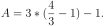 and
and  the following
is true
the following
is true

Show that for arbitrary square matrices and the following
is true

 denotes the transposition
Prove or give counterexample: if is a singular matrix, then
denotes the transposition
Prove or give counterexample: if is a singular matrix, then

Consider the following systems of equations:


 and the RHS
  of the
Newton method.
of the
Newton method.
Suppose that you use Newton method


(a)
Let  be an arbitrary square matrix, and let
  be an arbitrary
scalar.
be an arbitrary
scalar.
Prove or disprove the following statements:
(i)

(ii)
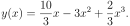
(b)
Let be an  diagonal matrix with
all its diagonal entries equal to
diagonal matrix with
all its diagonal entries equal to  .
.
(i) What is the value of
 ?
?
(ii) What is the value of
 ?
?
Consider the linear system
using two
decimal digit machine arithmetic.



In this problem
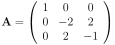
![\begin{indisplay}A =
\left[
\begin{array}{rr}
1 & -2 \\
-2 & 3
\end{array}\right]
\end{indisplay}](img437.svg)
 such that
 .
.
(b) Find a vector such that

Consider the  problem with
  and
and
![\begin{indisplay}
A =
\left[
\begin{array}{rr}
-1 & 1 \\
0 & \alpha
\end{arr...
... \ \
b =
\left[
\begin{array}{rr}
1 \\
1
\end{array}\right] \end{indisplay}](img441.svg)
 in
computed solution is small, but nonzero. Here
in
computed solution is small, but nonzero. Here  is an exact
solution, and
is an exact
solution, and  is a computed solution. For what values of
 , if any, the residual will be large?
HINT For what values of , if any, the matrix will be
ill-conditioned?
HINT If
The Kronecker delta (named after Leopold Kronecker) is a function of two variables, usually two integers, is defined as
 |
(9) |
Consider the matrix defined as

In other words, is a diagonal matrix with diagonal entries being equal to

 norm of this matrix?
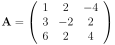
For the matrix
![\begin{indisplay}
{\bf A=}\left[
\begin{array}{rrr}
2 & -4 & 2 \\
1 & 0 & 5 \\
2 & -2 & 2
\end{array}\right]
\end{indisplay}](img449.svg)
 -factorization (show both
  and
and  matrices explicitly).
Consider the system
where
![\begin{indisplay}
{\bf A=}\left[
\begin{array}{rrr}
5 & 6 & 7 \\
10 & 20 & 23 \\
15 & 50 & 58
\end{array}\right]
\end{indisplay}](img451.svg)
![\begin{indisplay}
b =\left[
\begin{array}{r}
6\\
13\\
23
\end{array}\right]
\end{indisplay}](img452.svg)
or
![\begin{indisplay}
{\bf A=}\left[
\begin{array}{rrr}
1 & 3 & 5 \\
2 & 9 & 15 \\
2 & 18 & 37
\end{array}\right]
\end{indisplay}](img453.svg)
![\begin{indisplay}
b =\left[
\begin{array}{r}
22\\
65\\
149
\end{array}\right]
\end{indisplay}](img454.svg)
(a) Find explicitly factorization of .
(b) Use this decomposition to solve (11).
Consider the matrix
![\begin{indisplay}
{\bf B=}\left[
\begin{array}{rrr}
1 & 0 & 0 \\
2 & 1 & 0 \\
3 & 2 & 1
\end{array}\right]
\end{indisplay}](img455.svg)
 by representing the matrix as a
product of two elementary Gauss elimination matrices.
by representing the matrix as a
product of two elementary Gauss elimination matrices.
In this problem is a small positive number. Sketch the
two lines in the  plane, and describe how they change,
including the point of intersection, as approaches
zero. Also, calculate the condition number for the matrix, and
describe how it changes, when approaches zero.
plane, and describe how they change,
including the point of intersection, as approaches
zero. Also, calculate the condition number for the matrix, and
describe how it changes, when approaches zero.

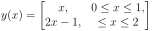
Prove that the one norm is the maximum absolute column sum; use  matrices.
Consider
matrices.
Consider
 |
(11) |
a) Find the LU factorization of the given matrix
b) Calculate the norms  ,
,
 , and
, and  for
this matrix
for
this matrix
c) Calculate the condition number for the matrix A.
Consider
 |
 and
and
 .
.

 norm of a vector is defined as a modulus of a maximum
component of a vector. As we learned in class, matrix norms are
defined through the vector norms as
norm of a vector is defined as a modulus of a maximum
component of a vector. As we learned in class, matrix norms are
defined through the vector norms as

Use this definition of the matrix norm through the
vector norm to proove that the norm of a matrix is a
maximum absolute row sum.
Complete the proof for matrices.
b
Extra credit 10% Prove this statement for general matrices.
Consider the system
where
 is small. The system has two approximate
solutions
is small. The system has two approximate
solutions
![${\bf\hat{x}=}[0,1]^{T}$](img472.svg) and
and
![${\bf\tilde{x}=}[1-5\varepsilon ,-1]^{T}.$](img473.svg) Find the norms of the respective
residuals. Which one is smaller? Find the condition number of the
matrix. Explain, why you should not use residuals in this case to
determine the quality of a solution.
Find the norms of the respective
residuals. Which one is smaller? Find the condition number of the
matrix. Explain, why you should not use residuals in this case to
determine the quality of a solution.
Hint: Find an exact solution to (13).
Hint
![\begin{indisplay}
\left[
\begin{array}{rr}
a & b \\
c & d
\end{array}\right] ^...
...}\left[
\begin{array}{rr}
d & -b \\
-c & a
\end{array}\right]
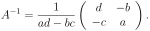
\end{indisplay}](img474.svg)
Calculate an inverse of the following matrix:
 |
(13) |
 .
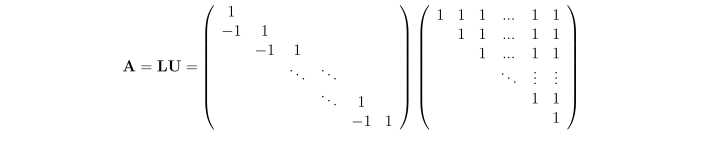
Let a
.
Let a
 matrix be factored as
follows:
matrix be factored as
follows:
 |
(14) |
![${\bf Ax=[}0,1,-1,1,...,-1,1]^{T}.$](img479.svg)
Consider the matrix
 |
?
 will the
computed value of the determinant be nonzero
factorization of ?
will the
computed value of be singular?
will the
computed value of the determinant be nonzero
factorization of ?
will the
computed value of be singular?
 , to solve the equation

Consider the following system of equations:
and the RHS of the
Newton method.
Let a  matrix be factored as
follows:
matrix be factored as
follows:
 |
the following equation:
 |
Chapter FOUR Consider the system of equations

 . NEW
. NEW
The Kronecker delta (named after Leopold Kronecker) is a function of two variables, usually two integers, is defined as
|
(15) |
Consider the matrix defined as
In other words, is a diagonal matrix with diagonal entries being equal to
.
.
Let the matrix have eigenvalues
 , and eigenvectors
 . Let the
matrix have eigenvalues
. Let the
matrix have eigenvalues
 and same
eigenvectors
. What are eigenvectors and eigenvalues
of the matrix
and same
eigenvectors
. What are eigenvectors and eigenvalues
of the matrix  given by
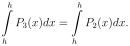
 |
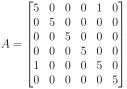
(16) |
a) Calculate the Eigenvalues and Eigenvectors for the given matrix
b) What Eigenvalue would the inverse power method converge to? Why?
c) What Eigenvalue would the power method converge to? Why?
d) Define
 . For this matrix, what Eigenvalue would the
power method converge to? Why?
. For this matrix, what Eigenvalue would the
power method converge to? Why?
Consider the matrix
Suppose that is a symmetric 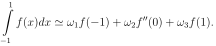 matrix with
eigenvalues
matrix with
eigenvalues

a) To which of these eigenvalues will the power method converge? Why
b) To which of these eigenvalues will the inverse power iteration converge? Why?
c) To what eigenvalue the power iteration method applied to the matrix

Consider

(a) Find eigenvalues and eigenvectors of .
(b) Find eigenvalues and eigenvectors of

Note that you do not have to calculate explicitly.
Chapter FIVE Given

 , use the points
 ,
,  and
and 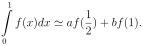 .
.
a) Find the piecewise linear interpolation function
b) find the quadratic interpolation function
Use a Lagrange interpolating polynomial of degree 2 to find an approx- imate value for the following. Not all of the data points are needed, and you should explain which ones you use and why.
(a)  if
if
 ,
,
(b) 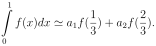 if
if
 ,
,
(c)  if
if
 .
.
Answer:
(a) Lagrange Polynomial is

 ,
,

(b) Lagrange Polynomial is


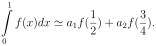
(c) Lagrange Polynomial is

 ,
,

Consider
 for
for
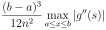
 for
for
 .
.
Solve for so that the given function is a natural cubic
spline from
 .
.
Use the theorems we studied in class to calculate the maximum error
in interpolating the function  by a polynomial of degree four
using five equally spaced points on the interval
by a polynomial of degree four
using five equally spaced points on the interval ![$[0,2\pi]$](img526.svg) .
Suppose you want to interpolate the function by a
polynomial of degree
.
Suppose you want to interpolate the function by a
polynomial of degree  by using
  equally spaced points on the
interval . How many points should you use so that the
difference between the sine function and your interpolation is less
that ?
equally spaced points on the
interval . How many points should you use so that the
difference between the sine function and your interpolation is less
that ?
This exercise explores some of the differences between a cubic poly-
nomial and a cubic spline. In this problem the data are:
 , and
, and
 .
.
(a) Find the global interpolation polynomial that fits this data, and then evaluate this function at x = 1/2.
(b) Find the natural cubic spline that fits this data, and then evaluate this function at x = 1/2.
(c) The cubic in part (a) satisfies the interpolation and smoothness conditions required of a spline, yet it produces a different result than the cubic spline in part (b). Why?
(d) What boundary conditions should be used so the cubic spline produces the cubic in part (a)?
Solution
5.26
(a)
Global polynomial interpolation is
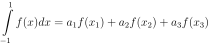
Writting spline as
 |
|||
 |
|||
 |
 |
|||
 |
|||
 |
|||
 |
|||
 |
|||
 |
 |
|||
 |
|||
 |

Result of part (a) does indeed satisfies interpolation and smoothness condition, but result in part (a) is not a natural spline
(d)To obtain result in (a) one would have to use clamped spline with

Find the clamped cubic spline  , which goes through the
points
, which goes through the
points
 and
and  at the beginning and the end of the domain, i.e.

Find the clamped cubic spline , which goes through the
points
 and
and  at the beginning and the end of the domain, i.e.

Consider the following piece-wise cubic function
 |
(17) |
Consider the following piece-wise quadratic polynomial
 |
(18) |
so that this function is a cubic
spline? If yes, what is the value of and is it natural, clamped
or not-a-knot spline? NEW
For a set of given data points
 , define the function


 'th Lagrange basis function can be expressed as

In general, is it possible to interpolate data points by a piecewise
quadratic polynomial, with knots at a given data points, such that the
interpolant is
that can be interpolated by
a piecewise quadratic polynomial that is twice continuously
differentiable?
Consider the following data:

(a) Find the global interpolation polynomial that fits these data.
(b) Find the piecewise linear interpolation function that fits these data.
(c) Find the natural cubic spline that fits these data.
answer
(a) By using methods we learned in class, we obtain the polynomial of degree two:

(b) Using Lagrange interpolation for the two subintervals, we obtain
 |
(19) |
(c) by repeating calculations that we have done in class, we obtain
 |
(20) |
Here we explore some of the differences between a cubic polynomial and a cubic spline. In this problem the data are:

(a) Find the global interpolation polynomial that
fits this data, and then evaluate this function at .
(b) Find
the natural cubic spline that fits this data, and then evaluate this
function at .
(c) The cubic in part (a) satisfies the interpolation and smoothness conditions required of a spline, yet it produces a different result than the cubic spline in part (b). Why?
(d) What boundary conditions should be used so the cubic spline produces the cubic in part (a)?
Solution:
5.26
(a)
Global polynomial interpolation is
Writting spline as
|
|||
|
|||
|
|
|||
|
|||
|
|||
|
|||
|
|||
|
|
|||
|
|||
|
Result of part (a) does indeed satisfies interpolation and smoothness condition, but result in part (a) is not a natural spline
(d)To obtain result in (a) one would have to use clamped spline with
Consider the following data

 has the following known values:
 such that
 .
HINT: Instead of using the data
.
HINT: Instead of using the data
 you may find it easier to use the data

Suppose that some measurements had produced the following data:

(i)
Write down second degree polynomial passing through all three points by using Lagrange interpolation
(ii)
Write down second degree polynomial passing through all three points by using Newton interpolation
(iii)
Show that the two polynomials obtained in (i) and (ii) are equivalent
Use appropriate Lagrange interpolating polynomial of to interpolate the following data:

What is the degree of interpolating polynomial? There is a catch in this question.
Consider the following data:

Determine the parabola (interpolating polynomial of
degree two) that interpolates the values of  for
for

Find the clamped cubic spline , which goes through the
points
and at the beginning and the end of the domain, i.e.
Find the clamped cubic spline , which goes through the
points
and at the beginning and the end of the domain, i.e.
Consider the following function

 a cubic spline for
 ? Make sure you justify your answer
Consider the logarithmic function  evaluated at the points
1,2 and 3:
evaluated at the points
1,2 and 3:

HINT: not-a-knot spline requires that the third derivative is
continuous at the first and last points.
Do not solve this system.
Suppose you were to define a piece-wise quadratic spline that
interpolates  given values

Write down in general form quadratic polynomials that
interpolate these points, such that the resulting piece wise
quadratic polynomial has continuous first derivative. How many
additional conditions are required to make a square system for the
coefficients of this quadratic spline?
This problem considers the function
 |
(21) |
a cubic spline for
?
This problem considers the function
 |
(22) |
and  , if any, is
a cubil spline for
? These values are to be used for the rest of this problem.
and is a natural cubic
spline?
and is a clamped cubic
spine?
, if any, is
a cubil spline for
? These values are to be used for the rest of this problem.
and is a natural cubic
spline?
and is a clamped cubic
spine?
Suppose you are given 4 point:

a
Suppose that you would like to obtain a quadratic spline that
interpolates the function  between the nodes 0, and .
?
b Given a function on a discrete set of data points. Explain the
difference between interpolation and approximation. What Is the difference
between an interpolating polynomial of degree  and an approximating
polynomial of the same degree ?
and an approximating
polynomial of the same degree ?
Is it possible to interpolate three points

Is it possible to interpolate four points

Suppose that you would like to obtain a quadratic spline that
interpolates the function between the nodes ![$[0,1,2]$](img589.svg) .
.
Suppose that you are given 4 experimental points:
 .
.
Is it possible to interpolate these 4 data points by piecewise quadratic polynomial with knots at these given data points, such that interpolant is
In each case, if the answer is “yes” explain why, and outline the procedure to find the interpolating function (you may use short form of the equations, do not solve the resulting equations); if the answer is “no”, explain why.
In class we have studied cubic splines, i.e. interpolation by a piece wise cubic polynomial with continious first and second derivative. It is possible to also introduce quadratic spline, i.e. piece wise quadratic polynomial with continious first derivative. Such qudratic spline is the focus of this problem.q
Consider the same data:
Interpolate this data by piece wise quadratic polynomial with continious first and second derivative at a middle point.
Extra Credit, 30 percent Suppose that one additional point is added to the above data, so that there are four points.

Is it possible to interpolate this data by piece wise quadratic interpolation with continious first and second derivatives at the interior points? Is it possible to do it in general?
Chapter SIX
Let  be a degree three polynomial, and let
  be
its degree two interpolating polynomial at the three points
be
its degree two interpolating polynomial at the three points  ,
and
,
and  . Prove by direct calculation that

 NEW
NEW
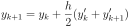
In class we have studied quadrature rules of the form


Chose the weights
 to maximize the precision of the quadrature. What is the
order of the resulting quadrature?
to maximize the precision of the quadrature. What is the
order of the resulting quadrature?
Derive the error term of this quadrature.
In class we have studied quadrature rules of the form

 to maximize the precision of
the quadrature. What is the order of the resulting quadrature?
to maximize the precision of
the quadrature. What is the order of the resulting quadrature?
HINT Solution of this problem will be much easier if you guess
the relationship between  ,
,  ,
,  and
and
 .
.
variation

Derive the error term of this quadrature.
Consider the qudrature rule of the form

Choose and to maximize the accuracy of the resulting
quadrature. Calculate the truncation error of the resulting
quadrature.
Is it more accurate or less accurate than Midpoint quadrature?
Given the points
 :
:

a) Evaluate the integral of the function using the midpoint rule
b) Evaluate the integral using Simpson's rule
c) Evaluate the integral using the trapezoid rule
(a) Consider the integration rule of the form
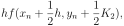
 and
and  to maximise the precision of this quadrature
rule 16 points
to maximise the precision of this quadrature
rule 16 points
(b) Calculate truncation error of this quadrature.
This problem concerns using numerical methods to calculate the integral


We are going to compare different ways to calculate this integral by
using the value of the function
 on only three points,
,
and .
on only three points,
,
and .
![$[0:1]$](img618.svg) interval find the
approximate value of this integral. What is the error?
interval find the
approximate value of this integral. What is the error?
Let us denote

As you know, we can calculate the value of this integral analytically:

Calculate the value of this integral numerically by using
Compare the result of your calculations with the exact value. Which of these four methods give the most accurate result? Is this consistent with your expectations?
(a) Consider the integration rule of the form
 and to maximise the precision of this quadrature
rule 16 points
and to maximise the precision of this quadrature
rule 16 points
(b) Calculate truncation error of this quadrature.
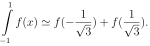
Find 3-point Gaussian rule for
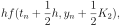
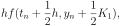 if the standard 3-point Gaussian rule is given by
![$\displaystyle \int_{a}^{a+h}g(x)dx=\frac{h}{2}\left[ g(a)+g(a+h)\right] -\frac{1}{12}%
h^{3}g^{\prime \prime }(s)
$](img624.svg)
 If interval is divided into equal panels, show
that the error of the composite trapezoid rule is bounded by
If interval is divided into equal panels, show
that the error of the composite trapezoid rule is bounded by

 within to
 by using the composite trapezoid rule.
(a) (10 points) In the three point quadrature rule
 , ,
, ,  , ,
, ,  and
and  to maximize the
precision of the quadrature rule. (The result will be three-point
Gauss quadrature.)
to maximize the
precision of the quadrature rule. (The result will be three-point
Gauss quadrature.)
(b) (5 points)What is the degree of the resulting scheme? Demonstrate this by showing the scheme correctly integrates a polynomial of that degree, and that it does not integrate correctly the polynomial of the degree of one order higher.
Find
 in
in


Hint Derivation is similar to calculation of the trapezoid
error term we did in class. You will need to express
 via
via  and its derivatives.
In class we have studied two point Gauss quadrature. In this problem you are to derive one point Gauss quadrature.
Consider the qudrature rule of the form

Choose and  to maximize the order (accuracy) of the resulting
quadrature. What is the truncation order of this quadrature?
to maximize the order (accuracy) of the resulting
quadrature. What is the truncation order of this quadrature?
Suppose that you have a tabular data, that is to say that the
function is given only on the equidistant points  ,
,
 such that
  ,
,  . Propose a way to
numerically evaluate
. Propose a way to
numerically evaluate

Chapter SEVEN
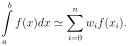
Find an  approximation of
  that utilizes
 ,
,
 , and
, and
 .
You are producing a final project for your Master's
Degree and need to solve Initial Value Problem
numerically. You prefer to have accurate numerical
solution. Out of Forward Euler, Backward Euler,
Trapezoidal, Heun (RK2), and Runge-Kutta (RK4) method,
which method would you choose and why?
.
You are producing a final project for your Master's
Degree and need to solve Initial Value Problem
numerically. You prefer to have accurate numerical
solution. Out of Forward Euler, Backward Euler,
Trapezoidal, Heun (RK2), and Runge-Kutta (RK4) method,
which method would you choose and why?
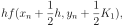
Consider RK2 (Heun's) method:


This can be done, for example, by showing that if at step  the
numerical solution is
the
numerical solution is

 the
numerical solution is equal to
the
numerical solution is equal to


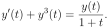
Suppose you are solving Initial Value Problem
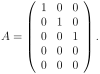
![$\displaystyle y_{j+1}= y_j + \frac{k}{3}\left[ f(t_j,y_j)+ 2 f(t_{j+1},y_{j+1})
\right].$](img656.svg)
Derive an finite difference approximation to  that
uses
that
uses
 ,
and
,
and
 . Calculate the
truncation error term of the resulting finite difference approximation.
. Calculate the
truncation error term of the resulting finite difference approximation.
variation
 ,
,  and
. Calculate the
and
. Calculate the
Find approximation of the first derivative  that uses ,
 and
and  . What is the error term of your
approximation?
. What is the error term of your
approximation?
For the equation
 consider the following
numerical method
consider the following
numerical method

Consider the following -step method for solving
for this method?
Is this method
explicit or implicit?
and , for which the method has the
highest possible accuracy.
SOLUTION Method of undetermined coefficients,  is satisfied
automatically,
is satisfied
automatically,  gives
gives  ,
,  gives
gives  .
Solving equations we get
.
Solving equations we get
 second order accurate
Determine whether the method
![$\displaystyle y_{k+1}=y_{k}+hf(t_{k},y_{k})+\frac{h^{2}}{2}\left[ \frac{\partia...
...{\partial t}+f(t_{k},y_{k})\frac{\partial f(t_{k},y_{k}%
)}{\partial y}\right]
$](img675.svg)
 is stable for the equation
 with
with
 .
.
Suppose you want to solve numerically
 for
for
 using 100 time steps (so,
  ). The method to be tried
are (i) the Euler method (ii) the backward Euler method (iii) the trapezoidal method (iv) the RK2 (Heun) method (v) the RK4 method.
). The method to be tried
are (i) the Euler method (ii) the backward Euler method (iii) the trapezoidal method (iv) the RK2 (Heun) method (v) the RK4 method.
(a) Which method do you expect to finish the calculation the fastests? Why?
(b) Which would be the second fastest method? Why?
(c) Which would be the most accurate method? Why?
(d) If stability is a concern, which method would be the best? Why?
This is general question. It is sufficient to give an answer with out proof.
Consider the following initial value problem
The following algorithm is proposed for its numerical solution:
![$\displaystyle y_{n+1} = y_n + \frac{h}{2}\left[ f(t_n,y_n)+f(t_{n+1}, y_{n+1})\right].$](img683.svg)
 for stability.
Consider the following initial value problem:
Using the Euler method with
 calculate
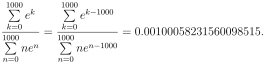
  and
and
 10 pt.
Is the proposed method numerically stable for the propsoed time step? 2 pt
Extra credit - 2 pt compare the result with the exact analytical solution.
computer the solution of

 using 100 time steps (i.e. with
 ). The methods to be tried are
Please answer the following questions:
Suppose you want to solve numerically
for
using 100 time steps (so, ). The method to be tried
are (i) the Euler method (ii) the backward Euler method (iii) the trapezoidal method (iv) the RK2 (Heun) method (v) the RK4 method.
(a) Which method do you expect to finish the calculation the fastests? Why?
(b) Which would be the second fastest method? Why?
(c) Which would be the most accurate method? Why?
(d) If stability is a concern, which method would be the best? Why?
IsHeun's method

 with ?
Consider RK2 (Heun's) method:


This can be done, for example, by showing that if at step the
numerical solution is
the
numerical solution is equal to
Consider the following initial value problem:

 with
with
 (i.e. calculate one time step).
( 4 points) Compare the result with the exact analytical solution.
State whether the following methods are (i) explicit or implicit (ii) single step or multi-step (iii) selfstarting or not. Cross out wrong statements and underline correct ones:

(i)explicit/implicit (ii)single step/multi-step (iii)selfstarting/not selfstarting.
(i)explicit/implicit (ii)single step/multi-step (iii)selfstarting/not selfstarting.

(i)explicit/implicit (ii)single step/multi-step (iii)selfstarting/not selfstarting.
The Bernoulli equation is

 through
  )?
)?
Consider the equation

 what is the resulting finite difference equation (i.e. equation
expressing through )?
?
what is the resulting finite difference equation (i.e. equation
expressing through )?
?
Consider the fourth order RK method:
Apply this RK4 method for solving the equation

 the numerical
solution is
the numerical
solution is
 the numerical solution
is equal to
the numerical solution
is equal to


Consider the fourth order RK method:
Apply this RK4 method for solving the equation

 .
.
Chapter EIGHT

Set up the linear least squares problem for
fitting the model
 to the
four data points
to the
four data points  ,
,  ,
,  ,
,  .
.
Set up and solve the linear least squares system



(a) Suppose you would like to fit the data points

 and by setting up a linear (overdetermined)
least square problem and solving it.
and by setting up a linear (overdetermined)
least square problem and solving it.
(b) Also calculate the residual.
Suppose you measure as a function of  and you get the following:
|
 |
| 0 | 2 |
| 1 | 1 |
| 2 | -2 |
| 3 | -1 |
Suppose you would like to fit this data by
 and by setting up a linear (overdetermined)
least square problem and solving it. Also calculate the residal.
and by setting up a linear (overdetermined)
least square problem and solving it. Also calculate the residal.
Consider the data

Apporximate this data by a constant, i.e. find such that

is a good fit for this data.
 , where



a Calculate the value of which minimized the
square of the second norm of the residual

b Calculate  and
and  . Sketch
 , ,
and . Verify that
, ,
and . Verify that
 . Is it so on your graph?
c Extra-credit, 5 points Obtain equation for that minimizes  instead of
traditional
instead of
traditional  . Do not solve the resulting equation.
What are the advantages and disadvantages of using instead of
?
. Do not solve the resulting equation.
What are the advantages and disadvantages of using instead of
?
Suppose that an experiment produced the following data:
a Calculate the value of which minimized the
square of the second norm of the residual
b Calculate and . Sketch
, ,
and . Verify that
. Is it so on your graph?
c Extra-credit, 5 points Obtain equation for that minimizes instead of
traditional . Do not solve the resulting equation.
What are the advantages and disadvantages of using instead of
?
 identity matrix,
 the vector

Find the least squares solution of

Let A be the  identity matrix
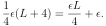 |
(36) |
![$\displaystyle b=[b_1, b_2, \dots, b_m]^{T}.$](img764.svg)





![\begin{indisplay}\left[
\begin{array}{ll}
4 & 2 \\
2+\varepsilon & 1+\varepsilo...
...ray}\right] =\left[
\begin{array}{l}
2 \\
1
\end{array}\right]
.\end{indisplay}](img470.svg)