


Next: Solution. Up: Numerical Computing MATH 4800 Previous: Condition Number Demonstration
Chapter ONE

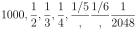 digits with base
  and
lower and upper values of exponents being
and
lower and upper values of exponents being  and
and  .
Subnormals are allowed.
.
Subnormals are allowed.
 and
number
and
number  (not counting
and .
(not counting
and .
 ?
?
 and
and  were to be
 and
and  ?
?
 and
and  be two adjacent positive Normalized
Single Precision floating point numbers.
and ?
and ?
and (for double numbers
be two adjacent positive Normalized
Single Precision floating point numbers.
and ?
and ?
and (for double numbers  ).
).
,  ,
,  ,
,  ,
and subnormals are allowed.
What is the maximum integer value of
,
and subnormals are allowed.
What is the maximum integer value of  for which the number

IEEE Single Precision has , , , ,
and subnormals are allowed.
In class we have shown that if is a real number, and  is its
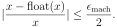
floating point representation, then the maximum possible relative error
in representing this number is given by
is its
floating point representation, then the maximum possible relative error
in representing this number is given by
where  is machine precision,

How the equation (1) changes for the subnormals?
To answer this question,
 .
How is going to be represented in IEEE SP?
on the computer number line?
and
.
How is going to be represented in IEEE SP?
on the computer number line?
and  ?
?
 such that
 ?
?
 . You
can guess the correct result by contemplating equation
(1).
such that
. You
can guess the correct result by contemplating equation
(1).
such that

Consider a floating-point arithmetic with base
 , precision
  and exponent range
 ![$[-16,16]$](img90.svg) . In other words, each number in this system
can be represented as
. In other words, each number in this system
can be represented as

 is integer, and all
 are either 0 or
  .
.

 and
and  such that
 is not equal to
  and such that
  is maximal.
(a) Find the largest open interval around  so that all
real numbers from the interval are rounded to
so that all
real numbers from the interval are rounded to  . That is, find
the smallest value of and the largest vlue of
. That is, find
the smallest value of and the largest vlue of  with
with  so
that any number from the interval
so
that any number from the interval  is rounded to the floating
point number
is rounded to the floating
point number  . Assume double precision is used (53 binary digits).
(b)
Redo the part (a) for the  , that is, find the interval
that rounds to the floating point number
, that is, find the interval
that rounds to the floating point number

IEEE SP has , , , .
Calculate  ,
,  and
and
 for this system.
Assume rounding by chopping.
for this system.
Assume rounding by chopping.
How many floating point numbers are there between any successive
powers of ? For example, how many floating point numbers are there
between 2 and 4?
Consider the floating point system with

(a)
What is the distance from number to
the next largest floating point number in this floating point
system?
(b)
What is the distance from number to the next smallest floating point number in this floating point system?
(c) What distance is larger, (a) or (b)? Why? What is the relation between
these distances and machine precision
 ?
?
, , ,
. What is the closest floating point number to
the number

, , ,
. What is the absolute error in representing
the number
, , ,
.
What is the closest floating point number to the number
and  , i.e.
 ?
?
 ?
?

a) Approximate  using third degree Taylor polynomial
expanded about
using third degree Taylor polynomial
expanded about  . Use this expansion to show that

b) Explain why MATLAB would compute the limit of  to be 0.
such that

 is a floating point
representation of the number .
is a floating point
representation of the number .

|
|
 |
|
 |
 |
 |
 |
 |
|
Please explain in details the values in the right column of this table.
can the number  be
represented exactly, with no rounding error in IEEE SP floating
point system?
be
represented exactly, with no rounding error in IEEE SP floating
point system?
Consider IEEE SP that has binary numbers , with  digits, and lower and upper values of the exponents of ,
. As we discussed in class, the number
digits, and lower and upper values of the exponents of ,
. As we discussed in class, the number
 is not
representable in IEEE SP. What is the Floating Point Number that
precedes
is not
representable in IEEE SP. What is the Floating Point Number that
precedes
 ? In other words, find the largest Floating
Point Number that is less then
.
? In other words, find the largest Floating
Point Number that is less then
.
Hint: your answer should contain 24 binary digits of the mantissa and the value of the exponent.
— addition
— subtraction
— multiplication
— division
If you answered “yes” to any of the questions, please give one example of two Single Precision numbers that produce overflow by given operation.
(b) Which of the following operations of two positive floating point numbers can produce underflow?
— addition
— subtraction
— multiplication
— division
If you answered “yes” to any of the questions, please give one example of two Single Precision numbers that produce underflow by given operation.
is not
representable in IEEE SP. What is the Floating Point Number that
precedes
? In other words, find the largest Floating
Point Number that is less then
.
Hint: your answer should contain 24 binary digits of the mantissa and the value of the exponent.
— addition
— subtraction
— multiplication
— division
If you answered “yes” to any of the questions, please give one example of two Single Precision numbers that produce overflow by given operation.
(b) Which of the following operations of two positive floating point numbers can produce underflow?
— addition
— subtraction
— multiplication
— division
If you answered “yes” to any of the questions, please give one example of two Single Precision numbers that produce underflow by given operation.
, with
digits, and lower and upper values of the exponents of ,
. What is the number that follows the number “zero”,
 in IEEE single precision? In other words, find the
smallest possible positive number that is representable in this
system. Write the result in both binary and decimal format.
in IEEE single precision? In other words, find the
smallest possible positive number that is representable in this
system. Write the result in both binary and decimal format.
Consider the following expression:


(a) for what values of it is difficult to calculate this
expresion accurately in floating point arithmetic?
(b)Give a rearrangement of the terms such that, for the range of in part
a, the computation is more accurate in floating point system
, with
digits, and lower and upper values of the exponents of ,
. What is the Floating Point Number that is before  ?
In other words, what is the largest Floating
Point Number that is
less then .
?
In other words, what is the largest Floating
Point Number that is
less then .
, with digits, and lower and upper values of
the exponents of , are used. Also, assume that the
“rounding to nearest” rule is used, and if there is a tie, a
smallest number is chosen.
— For what numbers will the computer claim that inequality
 is true?
— For what real numbers will a computer claim that
 ?
?
— Suppose it is claimed that the solution of  is
exactly representable in this system. Why it is not possible? What
is the distance between two floating point numbers that is right
above and right below solution of in this system?
is
exactly representable in this system. Why it is not possible? What
is the distance between two floating point numbers that is right
above and right below solution of in this system?
,
with  digits, with lower exponent of
  and upper exponent
 .
.
Consider the following claim: If the two positive binary floating
point numbers and in this toy floating point systems are
such that

 is exactly representable number in the floating
point system.
is exactly representable number in the floating
point system.
Is this claim true or false? If it is true, explain why, if it is false, find counter example.
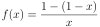
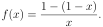
 is equal to one. However, when
we calculate on the computer for small value of , result is
not equal to . Here is a computer generated graph of
for small value of .
is equal to one. However, when
we calculate on the computer for small value of , result is
not equal to . Here is a computer generated graph of
for small value of .
Please explain why this graph looks the way it does.
In particular, answer the following questions:
is zero for
 ?
is zero for
?
is zero for
 ? Why the value
of zero on the left is twice longer than the value of zero on the
right?
jumps to the value of at
? Why the value
of zero on the left is twice longer than the value of zero on the
right?
jumps to the value of at
 ?
oscillate around for
?
oscillate around for
 ?
become larger
than for negative ?
?
become larger
than for negative ?
 .
.
 , three digits of accuracy
  and the lowest possible
exponent of
and the lowest possible
exponent of  .
.
 and
and
 , what is the
result of computing ?
?
, what is the
result of computing ?
?
IEEE SP has , , , . In single precision
floating point system write down the floating point number that
follows the number  . (In other words, find minimal value of
 , that is exactly representable in this floating point system.
IEEE SP has , , , . What is the
smallest possible positive integer that is not a single precision
number?
 decimal digits,
, let
decimal digits,
, let  and
and  .
.
 contain?
 and are exactly representable?
exctly representable, ragardless of
exponent range, if gradual underflow is allowed? Why?
and are exactly representable?
exctly representable, ragardless of
exponent range, if gradual underflow is allowed? Why?
Suppose one calculates using computer arithmetic the following number:

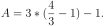 , so that

Determine whether the following examples may be used to determine machine precision:


You may find it helpful to use calculator to gain intuition for this problem.
Consider a floating-point number system with base
, precision and exponent range ![$[-10,10].$](img170.svg) I.e., in this system
any number can be written as
I.e., in this system
any number can be written as

(a) Write down two adjacent normalized numbers and such
that
 is minimal.
(b) In this floating-point system, what is the maximal possible
error of representing  by a machine number? What is the possible
relative error in representing by a machine number?
by a machine number? What is the possible
relative error in representing by a machine number?
(c) In this floating-point system, how many numbers are there
between number and number .
The following statments are either true or false. If true, provide
an explanation why it is true, and if it is false provide an example
demonstrating this along with an explanation why it shows the
statement is incorrect. In this problem is a real number and
 is its floating-point representation in Single Precision
with subnormals allowed. Furthermore, is machine
precision (unit round off).
is its floating-point representation in Single Precision
with subnormals allowed. Furthermore, is machine
precision (unit round off).
 , then
  .
.
 , then
  .
is a floating-point number with
.
is a floating-point number with
 , then there is an integer
so that
, then there is an integer
so that
 .
is a floating-point number, then
.
is a floating-point number, then
 is also floating-point number.
is a solution of
is also floating-point number.
is a solution of  , then is also a solution.
 .
.
Find whether the following numbers can be exactly represented in the Single Precision IEEE system. If the number is exactly representable, please write down the exact Floating Point Presentation of a number. If not, please explain why this number can not be represented.


What is the largest value of  for which the number

Please calculate by hand what a computer with single -precision arithmetic with subnormal allowed would produce in these examples.
Note that the terms must be evaluated in the order indicated by the parenthesis. Make sure to explain your steps.


Assume a decimal (base 10) floating point system having machine
precision
 and an exponent range of
  . What is the result of each of the following floating point
arithmetic operations?
. What is the result of each of the following floating point
arithmetic operations?


Chapter TWO
 by iterations, and you
have obtained
by iterations, and you
have obtained
 and
and
 . Now
use linear interpolation to find
. Now
use linear interpolation to find
 such
that
such
that
 . What is the resulting method of solving
that you have obtained?
. What is the resulting method of solving
that you have obtained?
 ,
,  .
.  and
and  are
parameters.
, , and
the point is a fixed point of this fixed point iteractions?
, and
for which the fixed point iteraction scheme
(2) with the function
(3) so that these
fixed point iterations does locally converge to .
, , and for which
fixed point iteration does not locally converge to 0.
are
parameters.
, , and
the point is a fixed point of this fixed point iteractions?
, and
for which the fixed point iteraction scheme
(2) with the function
(3) so that these
fixed point iterations does locally converge to .
, , and for which
fixed point iteration does not locally converge to 0.
What is the Single Precision Floating Point Number that follows 256 and the Single Precision Floating Point Number that preceeds 256? Write the answer in both binaries and decimals.


