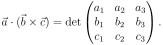
One way to see invariance under cyclic permutation is to recall that the scalar triple product equals the determinant of the matrix whose rows are the components of
(or whose columns are those vectors). That is,
A cyclic permutation of the rows of a determinant leaves the determinant unchanged (up to the permutation parity; specifically a cyclic permutation of rows is an even permutation and preserves the determinant). Therefore


 . The scalar triple product is defined by

 matrix whose rows are the components of
 (or whose columns are those vectors). That is,