


Next: Problem 4: Rapidly rotating Up: Problem 3: Convection with Previous: Behavior as varies
 ), the horizontal momentum equations become
 |
 |
(37) |
 |
 |
(38) |
 (or for two-dimensional –
 problems where
 so the
  -equation decouples except for Coriolis terms) the algebra becomes lengthier but follows the same elimination procedure. One obtains the inertia-gravity-wave dispersion relation modified by
  ; for the classical nonhydrostatic Boussinesq (
 ) the dispersion relation for two-dimensional inertia-gravity waves (with
  horizontal and vertical wavenumbers) is
 modification the denominator becomes
 , and the numerator picks up the
  contribution arising from coupling between
  and . The resulting dispersion relation (for waves with no
  -variation) can be written as
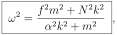
 and the classical inertia-gravity relation when . (Derivation omitted for brevity but follows straightforward elimination of
 as above.)