


Next: 4. Fourier-Space Hamilton's Equations Up: Fourier Tranform Previous: 2. Discrete Fourier Transform
Since  depends on all Fourier modes:
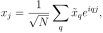 |
(35) |
 |
(36) |
Observation: For real , the Fourier modes satisfy
 . Therefore, the correct derivative that appears in Hamilton's equations is with respect to
 :
:
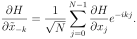 |
(37) |
Similarly, for momenta:
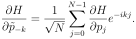 |
(38) |