Selection rules for the triple–sine overlap integral.

Consider

$\displaystyle I_{klm}
=
\int_{0}^{L}
\sin\!\left(\frac{k\pi x}{L}\right)
\sin\!...
...ight)
\sin\!\left(\frac{m\pi x}{L}\right)\,dx,
\qquad k,l,m\in\mathbb{Z}_{>0}.
$

  1. Parity rule. The integral vanishes unless the sum of the three mode numbers is odd:

    $\displaystyle I_{klm}=0$   if $\displaystyle k+l+m$    is even$\displaystyle .
$

    Equivalently, the interaction is nonzero only if an odd number of the indices $k,l,m$ are odd.

  2. Triad (index–sum) rule. A nonzero contribution arises only from combinations satisfying

    $\displaystyle \pm k \pm l \pm m =$   odd integer$\displaystyle ,
$

    which correspond to near-resonant conditions $m \approx k+l$ or $m \approx \vert k-l\vert$.

  3. Symmetry rule. The overlap integral is invariant under any permutation of the indices:

    $\displaystyle I_{klm}=I_{lmk}=I_{mkl}.
$

  4. Strength hierarchy. Among the admissible triads, the coupling coefficient is largest when one mode number is close to the sum or the absolute difference of the other two; triads far from these conditions are progressively weaker.

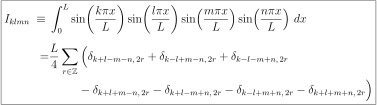
\begin{indisplay}\boxed{
\begin{aligned}
I_{klmn}
\;\equiv\;
&\int_{0}^{L}
\sin\...
...\delta_{k-l+m+n,\,2r}
-\delta_{k+l+m+n,\,2r}
\Big)
\end{aligned}}\end{indisplay}

$\displaystyle \boxed{
I_{klmn} = \frac{L}{8} \sum_{\text{all }\pm} (\pm)(\pm)(\pm)\;
\delta_{\,k \pm l \pm m \pm n,\, \text{even}}
}
$

Another version

Examples - SUM part:

$\displaystyle (1,2,3),\ (2,3,5),\ (3,4,7).$

Example - DIFFERENCE:

$\displaystyle (3,1,2),(5,3,2),(7,4,3).$