Next: 2. (a) Vector identity Up: Solutions Previous: Solutions
We derive the Euler momentum equation for an inviscid fluid by applying Newton's second law to a moving (material) fluid parcel and using the Reynolds transport theorem to relate integrals over a material volume to local fields. (The exam's wording mentions a "fixed control volume (fluid parcel)"; here we use a material volume  that moves with the fluid — i.e. the standard derivation.)
Let
 be the mass density and
 the velocity field. Newton's second law for the material volume (a fluid parcel) states

 is the body force per unit mass (e.g. gravity) and
  is the surface traction (force per unit area) acting on the boundary
 .
.
For an inviscid fluid the only surface force is pressure, so
 where
where  is the outward unit normal on
 . Thus

Apply the divergence theorem to the surface integral:
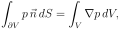

Now use the Reynolds transport theorem (RTT) for a material volume :

 .) Equating integrands (valid for arbitrary material volumes) gives the integral (and hence local) form:

This is the conservative form of the momentum equation. We can expand the left-hand side using the continuity equation


 vanishes by continuity, so we obtain the nonconservative (material-derivative) form:

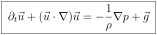
Finally, for an incompressible fluid of constant density  const, divide by
  to obtain Euler's momentum equation in its familiar form