Problem 5: Hockey puck inertial circle at Dartmouth ( $\phi=43^\circ$)

We are asked: on a frictionless hockey field at latitude $\phi=43^\circ$ with width $26$ m, how slowly should a puck be driven so that its inertial circle has diameter equal to the field width (i.e. diameter $=26$ m, radius $r=13$ m)?

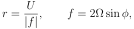
Recall inertial circle radius is

$\displaystyle r = \frac{U}{\vert f\vert},\qquad f = 2\Omega\sin\phi,$

so the required speed is $U = r f$. Using $\Omega=7.292115\times10^{-5}\,\mathrm{rad\,s^{-1}}$ and $\phi=43^{\circ}$ we compute

$\displaystyle f = 2\Omega\sin(43^{\circ}) \approx 9.9464\times10^{-5}\,\mathrm{s^{-1}}.
$

Thus

$\displaystyle U = r f = 13\,\mathrm{m}\times 9.9464\times10^{-5}\,\mathrm{s^{-1}} \approx 1.29\times10^{-3}\,\mathrm{m\,s^{-1}} \approx 1.3\ \mathrm{mm/s}.
$

This is extraordinarily slow: about $0.0013\,$m/s. The corresponding inertial period (time to complete one circle) is

$\displaystyle T = \frac{2\pi}{\vert f\vert} \approx \frac{2\pi}{9.9464\times10^{-5}} \approx 6.32\times10^4\,\mathrm{s} \approx 17.6\,\mathrm{hours}.
$

So to let a puck draw a full inertial-sized circle across the Dartmouth field would require driving it almost imperceptibly slowly (millimeters per second) and waiting many hours for one revolution.