Differentiate the first equation with respect to time and eliminate  using the second equation:
Thus
using the second equation:
Thus  satisfies a simple harmonic oscillator with frequency
  :
:
 |
(15) |
Using
 we integrate to get
 |
(16) |
but a constant  is excluded if we assume zero mean/component consistent with initial-value formulation; by direct substitution of initial conditions
  ,
,  we find
Notice that
we find
Notice that
 constant constant |
(19) |
so the speed
 is constant in time: inertial oscillations conserve kinetic energy when pressure and friction are absent.
The trajectory follows by integrating
 ,
,
 . Using the above forms one obtains
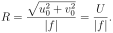
These parametric equations describe a circle. The radius  is
is
 |
(22) |
Hence the trajectory is a circle of radius  (using signed or absolute
  as appropriate).










