*

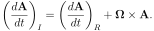
tSolution We recall a general vector time-derivative identity relating derivatives measured in an inertial frame (subscript $I$) and a rotating frame (subscript $R$) with constant rotation vector $\boldsymbol{\Omega}$. For any vector $\mathbf{A}$ (expressed in the rotating-frame basis),

$\displaystyle \left(\frac{d\mathbf{A}}{dt}\right)_I = \left(\frac{d\mathbf{A}}{dt}\right)_R + \boldsymbol{\Omega}\times\mathbf{A}.$ (3)

This identity follows because the rotating-frame basis vectors themselves change with time: $d\hat{e}_i/dt = \boldsymbol{\Omega}\times\hat{e}_i$ (for constant $\Omega$).

Apply ([*]) to the position vector $\mathbf{r}$. The inertial velocity is

$\displaystyle \mathbf{V}_I = \left(\frac{d\mathbf{r}}{dt}\right)_I = \left(\fra...
...l{\Omega}\times\mathbf{r} = \mathbf{V}_R + \boldsymbol{\Omega}\times\mathbf{r}.$ (4)

Differentiate again using ([*]) (applied to $\mathbf{V}_R$ and remembering $\boldsymbol{\Omega}$ is constant):

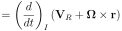
$\displaystyle \left(\frac{d\mathbf{V}_I}{dt}\right)_I$ $\displaystyle = \left(\frac{d}{dt}\right)_I(\mathbf{V}_R + \boldsymbol{\Omega}\times\mathbf{r})$ (5)
  $\displaystyle = \left(\frac{d\mathbf{V}_R}{dt}\right)_I + \left(\frac{d}{dt}\right)_I(\boldsymbol{\Omega}\times\mathbf{r}).$ (6)

Using ([*]) on the first term and on the vector $\boldsymbol{\Omega}\times\mathbf{r}$ yields

$\displaystyle \left(\frac{d\mathbf{V}_I}{dt}\right)_I$ $\displaystyle = \left[\left(\frac{d\mathbf{V}_R}{dt}\right)_R + \boldsymbol{\Om...
...bf{r}) + \boldsymbol{\Omega}\times(\boldsymbol{\Omega}\times\mathbf{r})\right].$ (7)

But $\boldsymbol{\Omega}$ is constant, so

$\displaystyle \left(\frac{d}{dt}\right)_R(\boldsymbol{\Omega}\times\mathbf{r}) ...
...\left(\frac{d\mathbf{r}}{dt}\right)_R = \boldsymbol{\Omega}\times\mathbf{V}_R.
$

Therefore,

$\displaystyle \left(\frac{d\mathbf{V}_I}{dt}\right)_I$ $\displaystyle = \left(\frac{d\mathbf{V}_R}{dt}\right)_R + \boldsymbol{\Omega}\t...
...es\mathbf{V}_R + \boldsymbol{\Omega}\times(\boldsymbol{\Omega}\times\mathbf{r})$ (8)
  $\displaystyle = \left(\frac{d\mathbf{V}_R}{dt}\right)_R + 2\boldsymbol{\Omega}\...
...s\mathbf{V}_R + \boldsymbol{\Omega}\times(\boldsymbol{\Omega}\times\mathbf{r}).$ (9)

Rearranging gives the desired relation (with $\mathbf{V}_g$ denoting the velocity measured in the rotating frame, which here we have called $\mathbf{V}_R$):

$\displaystyle \boxed{\;\left(\frac{d\mathbf{V}_R}{dt}\right)_R = \left(\frac{d\...
...thbf{V}_g - \boldsymbol{\Omega}\times(\boldsymbol{\Omega}\times\mathbf{r})\; }.$ (10)

This completes the derivation.